CSP / KO Onboarding using e-Signature with e-Aadhaar
A complete guide to legally valid Aadhaar-based e-signatures, helping Corporate Business Correspondents onboard CSPs / KOs quickly, securely, and paper-lessly.

What is an e-Signature?
An electronic signature (e-signature) is the digital form of a traditional handwritten signature. It is applied to specific documents that require authenticity and consent from one or more parties.
E-signatures are fast, secure alternatives to wet-ink signatures, and are very easy to use. Typically, the signer verifies their identity by entering an OTP delivered to their registered mobile number or email. Once signed, information such as IP address, location and time can be stored as part of the audit trail, helping prove authenticity.
Under the hood, digital signature tools use cryptographic algorithms. The document to be signed and the signer’s private key are combined to create a unique encrypted output – a digital “thumbprint” or hash. This is what actually gets signed and verified.
In India, the Information Technology Act, 2000 together with the Indian Contract Act govern e-signatures. A signer obtains a Digital Signature Certificate (DSC) from a licensed Certifying Authority (CA) approved by the Controller of Certifying Authorities (CCA). With this, users can electronically sign PDFs and other documents in a legally valid way.
Types of Signatures
A signature essentially expresses agreement to certain terms, like those in a contract. For a signature to serve this purpose, it must be unique to the signer and verifiable. Over time, signatures have evolved to keep these requirements intact.
Offline vs Online Signatures
| Criteria | Offline Signature | Online Signature |
|---|---|---|
| Nature | Paper-based and requires physical presence of the signer. | Fully digital; signatures can be applied remotely over the internet. |
| Legality | Legally valid, but vulnerable to forgery or tampering. | Legally valid under the IT Act, 2000 (dongle-based DSC and OTP-based eSign), with strong validation mechanisms. |
| Viability | Limited reach; difficult to scale across locations and geographies, especially for high-volume operations. | No geographic restriction – documents can be signed from anywhere in the world with internet access. |
| Security | Prone to document loss, fraud and manual errors. | Uses strong cryptography and audit trails to ensure integrity, traceability and non-repudiation. |
| Cost | Appears inexpensive but requires paper, printing, storage and manual handling. | Much cheaper at scale. Only an internet-enabled device is needed; most costs are operational rather than physical. |
What is Aadhaar?
The word “Aadhaar” literally means “foundation” in Hindi. Aadhaar is India’s large-scale digital identity system managed by UIDAI. It stores each resident’s 12-digit Aadhaar number along with name, address, age, gender and biometric details such as fingerprints and iris scans in a secure cloud database.
Launched in 2009, Aadhaar was designed to help the State deliver welfare benefits efficiently to eligible beneficiaries. Today, banks, insurance companies and government departments widely use Aadhaar-based biometric authentication to verify identity.
Aadhaar is part of the broader India Stack, a set of digital public infrastructure layers that make it possible to store and share data (like birth certificates, medical records, tax returns and statements) and to link payments via UPI, BHIM and Aadhaar Pay.
Aadhaar’s Foundations
UIDAI captures both biometric and demographic data when a resident enrolls. This information is used for de-duplication to ensure each Aadhaar number is unique.
Note: This set of demographic information is captured only for self-enrolment into Aadhaar.
Strong Customer Authentication & Legal Basis
Aadhaar-based e-sign integrates well with the concept of Strong Customer Authentication (SCA), which requires at least two of the following:
- Possession – something the user owns (e.g. device, token, OTP).
- Knowledge – something the user knows (e.g. password, PIN, secret answers).
- Inherence – something the user is (e.g. biometrics, face, voice).
Aadhaar meets the possession and inherence criteria by combining registered mobile-based OTPs with biometrics.
IT Act, 2000 – Criteria for Legality
In India, the IT Act, 2000 and the Indian Contract Act together define the legal status of electronic signatures. Section 2(1)(a) defines an “electronic signature” as the authentication of an electronic record using an electronic technique specified in the Second Schedule, including digital signatures.
Sections 3 and 5 of the IT Act recognise digital signatures and electronic signatures for validation of electronic records, while subsequent amendments and the 2015 rules clarify approved methods and the role of licensed Certifying Authorities (CAs).
The Indian Evidence Act has also been updated so that properly executed electronic records and electronic signatures are admissible as evidence in court.
When is an e-Signature Valid?
Under Section 3A and its related provisions in the IT Act, an electronic signature is considered valid when the following conditions are met:
- The data used to create and verify the signature is uniquely linked to the signer.
- At the time of signing, the signer has sole control over the data used to create the electronic signature.
- Any change to the signature, signed data or related information after signing is detectable.
- The Central Government’s prescribed standards and procedures are followed, and the CA issuing the certificate is authorised by the CCA.
- A clear audit trail is available that records the signing steps and events.
Signatures issued via a licensed Certifying Authority using approved methods are treated as reliable by default; other electronic signatures must demonstrate reliability as per the above criteria.
Which Documents Can Be e-Signed?
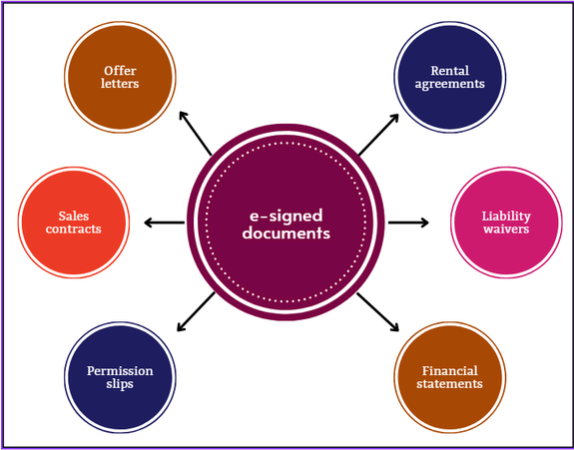
A wide range of everyday documents can be executed using electronic signatures, including:
- Offer letters and employment letters.
- Sales contracts and commercial agreements.
- Permission slips and consent forms.
- Rental / lease agreements.
- Liability waivers and declarations.
- Financial statements and related records.
A 2022 amendment to the IT Act expanded the scope of documents that may be e-signed, including:
- Cheques, demand promissory notes and bills of exchange governed by regulators such as RBI, NHB, SEBI, IRDAI and PFRDA.
- Powers of Attorney executed in favour of entities regulated by these authorities.
- Agreements relating to sale or transfer of interests that are allowed to be executed electronically.
Some instruments still require physical signatures and, where applicable, registration with a Registrar or Sub-Registrar. These include:
- Trust deeds.
- Negotiable instruments for transactions between individuals.
- Wills and other testamentary documents.
- Powers of Attorney executed between individuals.
How Does Aadhaar e-Sign Work?
Under the IT Act, India recognises two primary e-signature methods: OTP-based eSign and USB token / DSC-based signatures. Aadhaar e-Sign falls under the OTP-based category.
A one-time password (OTP) is sent to the signer’s registered mobile number and / or email ID. The signer enters this OTP on the e-sign portal to authorise the signature. Aadhaar e-Sign uses this method in conjunction with UIDAI.
A Digital Signature Certificate is stored in a secure USB token. The signer plugs this into their computer and uses it to sign documents in bulk via Public Key Infrastructure (PKI).
Step-by-Step Aadhaar e-Sign Flow
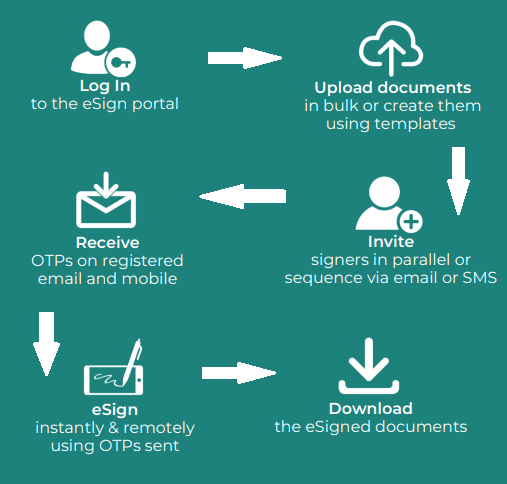
- The user logs in to the Sanjivani e-sign portal.
- Required documents are uploaded (individually or in bulk).
- The user adds one or more signers, specifying their name and email, and optionally the signing order (parallel or sequential).
- The system sends signing invitations via email and SMS.
- The signer opens the secure link and previews the document.
- The signer confirms their name as per Aadhaar and proceeds.
- The system redirects to NSDL / authorised ASP where the signer enters their Aadhaar number and requests an OTP.
- An OTP is sent to the Aadhaar-linked mobile number.
- The signer enters the OTP; on successful validation, the document is signed.
- Once all signers are done, the fully signed document is emailed to all parties.
Advantages of e-Signing the Aadhaar Way
Aadhaar-based e-Sign is transforming how different sectors handle high-volume paperwork and approvals:
Finance & Banking
Banks, NBFCs and other financial institutions manage millions of forms – mandates, permissions, sanction letters and loan agreements. Sanjivani’s e-signature workflow integrates with core banking, loan origination and CRM / ERP systems to generate, route and e-sign documents in minutes instead of weeks.
Legal Fraternity
Legal teams rely heavily on accurate documentation. With Aadhaar e-Sign, they can templatise common agreements, negotiate terms, and execute contracts digitally. Strong signer verification and detailed audit trails support compliance and due diligence.
Healthcare & Medical
Hospitals and healthcare providers can automate consent forms, pre-authorization letters, claims documents and prescription slips using e-Sign flows. Multiple signing options – Aadhaar, PAN-based, DSC-based and electronic signatures – can be offered as required.
Insurance
Insurers can issue policies and endorsements digitally, with proposal forms and declarations e-signed by customers. IRDAI’s push for complete digitisation enables OTP-based customer consent and electronic policy documents.
Retail & FMCG
Retailers and FMCG companies interact with numerous vendors and partners. Vendor onboarding, distributorship agreements and other contracts can be issued and signed online, ensuring faster go-live and smoother supply-chain operations.
Corporate Business Correspondent Model
Sanjivani’s proposal focuses on deploying the Corporate Business Correspondent (BC) model using e-Aadhaar signed documents. This model enables banks and financial service providers to extend banking and allied services to underserved and rural / semi-urban populations.
By using Aadhaar-based digital verification for CSP / KO onboarding, institutions can:
- Onboard CSPs / KOs instantly with secure e-KYC.
- Eliminate most physical paperwork and manual data entry.
- Reduce fraud risk and identity-related disputes.
- Meet regulatory and audit requirements efficiently.
- Scale outreach across villages and small towns at lower cost.
The model includes clear partnership frameworks with banks and other financial institutions, technology integration plans, risk-mitigation and scalability strategies – all aimed at creating a robust, tech-driven financial inclusion platform.
Benefits of e-Aadhaar Signed Agreements
-
Legally Valid & Secure
e-Aadhaar is digitally signed by UIDAI and is legally recognised under the IT Act, 2000. The embedded digital signature ensures document authenticity and prevents tampering. -
Convenient & Always Available
Residents can download e-Aadhaar anytime from the UIDAI portal, removing dependency on physical cards. -
Environment-Friendly
Digital documents reduce paper usage, printing and physical storage. -
Instant Verification
Organisations can verify e-Aadhaar instantly using UIDAI’s verification tools, lowering turnaround time and fraud risk. -
Tamper-Proof
Any change to a digitally signed e-Aadhaar can be detected, making it highly reliable for KYC and identity verification. -
Widely Accepted
Government departments, banks, telecom providers and many businesses accept e-Aadhaar for KYC. -
Enhanced Privacy
e-Aadhaar is password-protected, ensuring only authorised persons can open and view it. -
Less Dependence on Physical Cards
Users do not have to carry the physical Aadhaar card everywhere, reducing risk of loss or damage.
Why Choose Our Aadhaar e-Sign Solution?
- Direct integration of CSP / KO masters into the signing workflow, eliminating duplicate data entry and reducing errors.
- Cost-effective pricing – charged per document / CSP rather than per signature, leading to substantial savings for CBCs.
- Multiple logins supported without extra license cost, ideal for distributed teams.
- Federal structure that allows document initiation and signing at branch / regional levels.
- Comprehensive audit trail for all events to protect against fraud, disputes and unauthorised changes.
- Extensive MIS and analytics covering financial, operational and business metrics.
- Highly flexible and responsive team open to custom requirements and new ideas from CBC partners.
Conclusion
e-Aadhaar signed documents offer a secure, convenient and legally robust way to prove identity and access services. Their digital nature enhances accessibility, security and trust, making them a powerful alternative to physical documents.
For Corporate Business Correspondents, combining Aadhaar e-Sign with Sanjivani’s tailor-made workflow helps drive financial inclusion at scale, ensures efficient service delivery and strengthens confidence in digital transactions.
Instantly e-Sign Documents with Sanjivani’s Aadhaar e-Signature
Our clients routinely cut contract execution time from weeks to under ten minutes using our e-signature workflow and document management platform. Templates, bulk uploads and automated routing make it easy to prepare, send and track agreements with Aadhaar, PAN, DSC and electronic signatures.
Businesses can create, e-sign and manage all CSP / KO and internal agreements through a single portal, with unlimited e-signing and delegated signing options.